


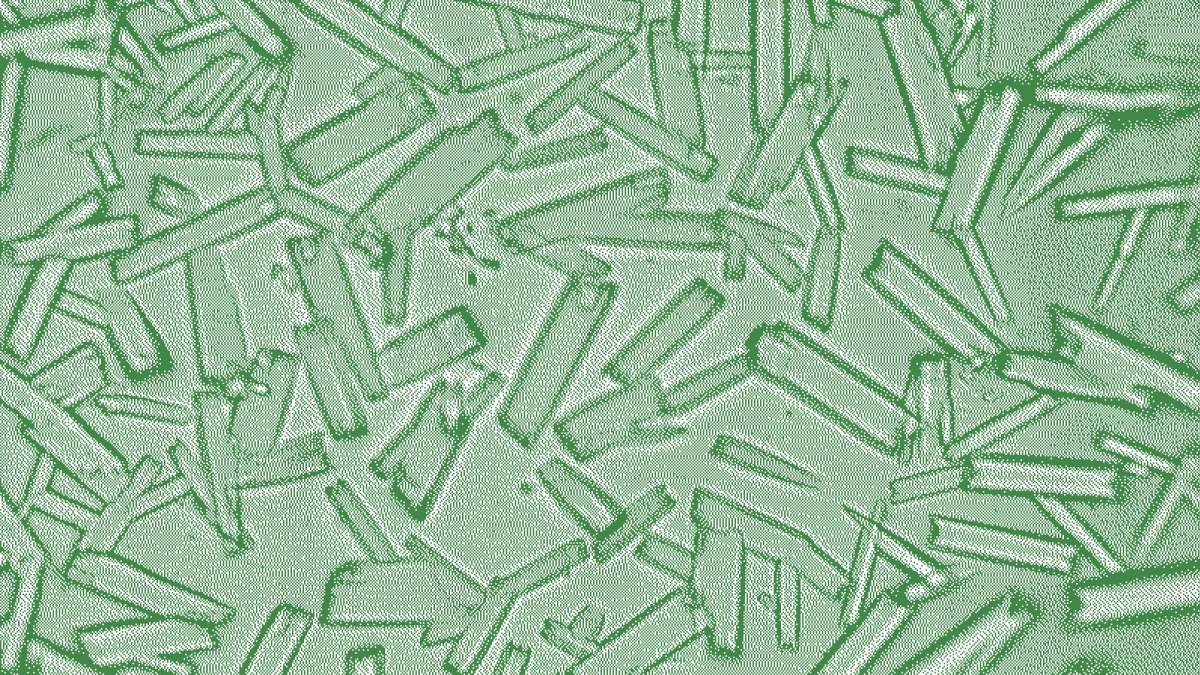


OXtal predicted molecular crystal structures (gray) compared against ground-truth crystal structures (green).
In 1988, the editor of Nature famously called the inability to predict crystal structures from chemical composition a "continuing scandal" in the physical sciences. Nearly forty years later, Crystal Structure Prediction (CSP) remains a grand challenge in computational chemistry, with high stakes for everything from drug stability to semiconductor performance.
Today, we are excited to highlight the work of FutureHouse AI-for-Science Post-doctoral Fellow Chenghao Liu, who, alongside a collaborative team from Caltech, University of Oxford, Mila, and AITHYRA, is changing how we approach this problem.
Introducing OXtal
OXtal is a new 100M parameter all-atom diffusion model that predicts experimentally realizable 3D organic crystal packings directly from a set of 2D molecular graphs.
Traditionally, predicting these structures is a brute-force process. It relies on running physics-based simulations on large CPU clusters to search for stable states. In the most recent CSP Blind Test, predicting just seven targets consumed 46M CPU core hours. OXtal replaces this prohibitively expensive search with a generative inference process, producing accurate predictions in seconds on a single GPU.
Scaling with Soft Symmetries
Rather than relying on hard-coded symmetries often used in this problem, OXtal uses scale and data augmentation instead—i.e., soft symmetries as an inductive bias. By training on over 600,000 experimentally resolved structures with a novel cropping algorithm, the model learns the local "packing puzzle" of how molecules sit next to one another. By solving for this local neighborhood, the global crystal structure emerges naturally.
This work represents a significant step toward high-throughput screening for pharmaceuticals and organic semiconductors, offering a high-speed filter that can sit upstream of traditional, expensive physics-based validation.
For more details, please visit the links below.
Project page: https://oxtal.github.io/
Preprint: http://arxiv.org/abs/2512.06987

