


What is an AI Scientist?
AI Scientists take broad scientific questions and autonomously generate hypotheses, design experiments, analyze data, and produce novel discoveries.
FutureHouse has been building toward this since 2023. Here's how we think about it — and why it matters.
The Idea
The term "AI Scientist" has been around longer than most people realize. It first appeared in the 1980s, referring to human scientists who work on artificial intelligence. The meaning flipped around 2008 to mean computer systems that do science. In recent years, the concept has moved from academic speculation to an active and fast-growing field.
Today, "AI Scientist" gets used loosely. Sometimes it means any system that uses AI to automate some piece of the scientific process. Under that broad definition, a chatbot with a literature search tool would qualify.
FutureHouse co-founder Andrew White has proposed something more precise:
An AI Scientist is a system whose input is a general direction of discovery and whose output is experimental results, analysis, and a paper describing a novel discovery — one that could pass peer review in a specific domain.
That's the bar. It's high. No system has fully cleared it yet, including ours. But the pieces are falling into place, and they're doing so faster than most people expected.
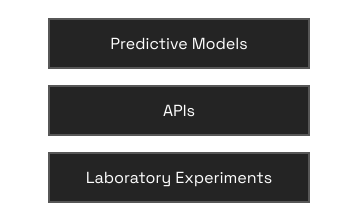
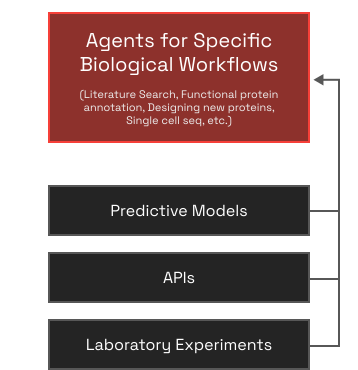
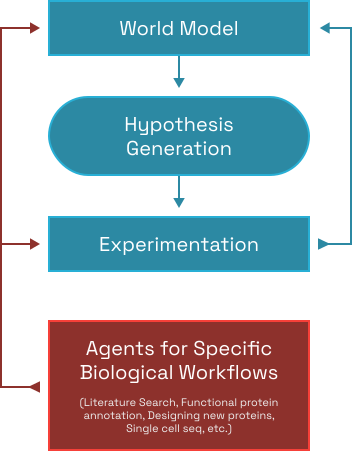
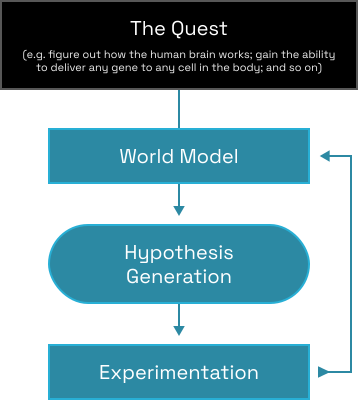
Four Layers of Science Automation
Not every AI system that touches science is an AI Scientist. We think about science automation in four layers — a framework FutureHouse developed to distinguish between what exists today and what we're building toward.


Let's explore each layer.


The Challenge
An AI Scientist doesn't replace human scientists. It multiplies them.
A single researcher working with an AI Scientist can cover ground that would previously require a full team. Our AI Scientist Kosmos can compress 6 months of research into a single day.
For diseases that affect millions but don't attract large research programs. For rare conditions. For questions that fall between disciplines. For the thousands of important biological problems that simply don't have enough people working on them, this changes the equation.
That's where FutureHouse lives.


